What identity diamonds really mean for you


When you first hear the phrase “identity diamond,” it’s easy to assume it refers to some kind of official certification or technical fingerprint used by gemologists. But that assumption misses the most emotionally resonant definition entirely. For those drawn to personalized jewelry, an identity diamond can mean something far more intimate: a gem that literally carries a piece of you or someone you love inside it. This guide cuts through the confusion, lays out the real science, and helps you figure out which form of identity diamond actually matches what you’re looking for.
Table of Contents
Key Takeaways
Point | Details |
Identity has vendor-specific meaning | The term ‘identity diamond’ can refer to several personalization types, especially DNA embedding or meaning-focused narratives. |
DNA gems vs. digital fingerprints | DNA-infused gems are different from structural fingerprinted traceable diamonds, each serving unique emotional or security needs. |
Personal value is paramount | It’s the emotional story and intent behind the diamond—not just the technology—that creates lasting meaning. |
Many personalization methods exist | From DNA infusion to custom engraving, you can create a diamond that matches your intentions and memories. |
Choose with your heart and mind | Focus on what resonates with you—be it legacy, memorial, or symbol—when selecting an identity diamond option. |
What does ‘identity diamond’ really mean?
The term “identity diamond” sounds official, but it’s not regulated or standardized in any way. As one industry report confirms, “identity” is not a standardized industry term and can refer to several personalization mechanisms. That’s both freeing and confusing at the same time.
Different jewelers and brands apply the word “identity” to very different things. One company might use it to mean a gem grown using carbon extracted from a person’s hair. Another might use it to describe a diamond with a laser-etched inscription of a name or date. A third might frame it as a story-driven design, where the gem’s cut, color, or setting represents something meaningful about the wearer’s life.
Here’s a quick breakdown of how “identity” gets applied across the industry:
DNA embedding: Carbon extracted from hair, nails, or ashes is used in the diamond-growing process, making the gem biologically connected to a specific person or pet.
Carbon source labeling: Some lab-grown diamonds track and disclose where their carbon came from, giving the gem a traceable origin story.
Laser inscriptions: Text, symbols, or images are etched onto the diamond’s surface or girdle to add personal meaning.
Meaning-based design themes: The gem is shaped, colored, or set in ways that reflect a personal narrative, cultural identity, or commemorative intention.
“Identity in diamonds is what you decide it means to you. The gem becomes a vessel for your story, not a standardized product category.”
None of these approaches is more “correct” than the others. But they serve very different purposes. If you’re researching DNA memorial diamonds explained, you’ll quickly see that the DNA infusion approach carries the deepest emotional weight for most people seeking true personalization. Knowing the distinction up front saves you from a lot of frustrating searches and misdirected purchases.
The technology: DNA-infused diamonds vs. digital identities
Here’s where things get genuinely interesting, and where the biggest source of confusion lives. There are two very different technologies that get grouped under the “identity diamond” umbrella, and they solve completely different problems.
Traceability diamonds (digital identity): These use structural fingerprinting or blockchain-backed documentation to track where a diamond came from, which mine or lab, which batch, which supply chain. The goal is anti-fraud and ethical sourcing verification, not personal meaning. As noted in research on diamond traceability technology, identity diamonds are conceptually adjacent to traceability and digital identity technologies for diamonds, but embedding DNA is entirely distinct from that approach.

DNA-infused diamonds (emotional identity): These use actual biological material, usually a few strands of hair or a nail clipping, to extract carbon. That carbon then becomes part of the diamond itself during the lab-growing process. The result is a gem that is physically, chemically, and symbolically tied to a real person.
Feature | Traceability diamonds | DNA-infused diamonds |
Primary purpose | Anti-fraud, provenance | Personal memorial, keepsake |
Technology used | Structural fingerprinting, blockchain | Carbon extraction from DNA source |
Emotional value | Low to moderate | Very high |
Verification method | Digital records, certificates | Documentation, lab certification |
Who it’s for | Ethically conscious buyers | People seeking deep personalization |
Time to create | Varies | As fast as 2 hours |
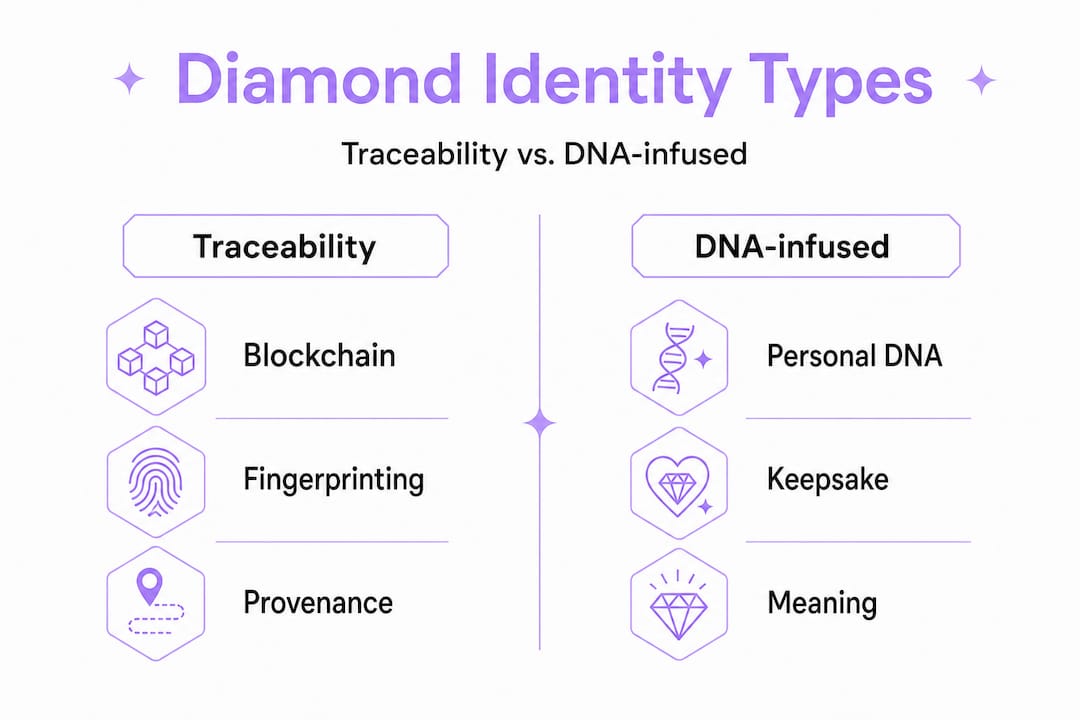
The distinction matters because personalized DNA diamonds are not about proving a diamond’s origins in any commercial or ethical sense. They’re about creating something that holds a piece of a person’s biological identity inside a gem that will last forever.
Pro Tip: When talking to any jeweler about “identity diamonds,” ask them directly which definition they’re using. Are they talking about traceability, or about DNA infusion? The answer tells you everything about whether they can deliver what you actually want.
Understanding the full DNA diamond creation process also helps set realistic expectations. Modern techniques have made it possible to go from sample collection to finished gem in as little as two hours. That speed doesn’t diminish the depth of the result.
Why choose an identity diamond? Emotional and practical benefits
Understanding the technology is only half the journey. The true power of identity diamonds lies in the connections and emotions they represent. People choose personalized gems for deeply human reasons, and those reasons tend to fall into a few clear categories.
Lab-grown diamonds infused with a customer’s DNA are described as “deeply personal keepsakes” that hold significance far beyond their material value. That’s not marketing language. It reflects what happens when people actually hold a gem they know contains part of themselves or someone they’ve lost.
Here are the most common motivations people bring to this decision:
Memorial and grief: Transforming a loved one’s hair, ashes, or even a pet’s fur into a wearable diamond gives grief a physical home. Instead of an urn on a shelf, you carry them with you.
Celebrating a relationship: Couples are increasingly choosing DNA diamonds as engagement or anniversary gifts, using each other’s DNA to literally fuse their identities into one gem.
Marking a major life milestone: A graduation, a recovery, a new chapter. A DNA diamond becomes a permanent record of a moment that changed everything.
Creating a family heirloom: Unlike jewelry that simply gets passed down, a DNA-infused diamond carries actual biological legacy from generation to generation.
Honoring a pet: The bond between a person and their animal companion is real and profound. Many people are using pet fur or ashes to create diamonds that honor that bond.
“The most powerful jewelry doesn’t just look beautiful. It holds memory, weight, and meaning that you feel every time you wear it.”
Exploring diamond keepsake examples from real clients gives you a sense of just how varied and moving these motivations can be. Some people commission a gem within weeks of a loss. Others plan years ahead to create something intentional and celebratory.
Pro Tip: Think about who the gem is for before you think about what it will look like. That single decision, memorial vs. celebration vs. legacy, should guide every choice you make after, from the personalization method to the setting style. Tips for meaningful custom gems are a great starting point for this kind of planning.
Popular personalization methods and their meanings
Curious about your options? The market for identity diamonds has grown enough that you now have several real, well-developed paths to choose from. Each signals meaning in a different way.
Different vendors use “identity” to mean DNA embedding, carbon source, inscriptions, or broader meaning narratives, which is why clarity about your own intention matters so much before you start shopping.
Personalization method | What it means | Best for |
DNA infusion from hair/nails | Biological connection to a living person | Couples, self-expression, living legacy |
Carbon from ashes | Memorial connection to someone who passed | Grief, memorial jewelry |
Pet fur or ashes | Honoring an animal companion | Pet memorials |
Laser inscription | Text or symbol added to the gem | Anniversaries, celebrations, milestones |
Carbon source selection | Choosing ethically or symbolically significant carbon | Environmentally conscious buyers |
Design theme | Cut, color, and setting reflect personal narrative | Artistic expression, cultural identity |
Here are the key factors that should guide your choice:
What feeling do you want the gem to create? A DNA diamond creates intimacy and biological connection. An inscription creates legibility and shared meaning.
Who will wear or receive it? Memorial gems often serve the living as much as they honor the departed.
How much personalization do you want? DNA infusion is the most deeply personal. Inscriptions are more visible and communicable to others.
What is your timeline? Some methods take weeks or months. The fastest DNA infusion processes now take as little as two hours from sample to finished gem.
Browsing custom collector gems shows how much variety exists even within a single method. Two people using DNA infusion can end up with entirely different gems based on cut, setting, and gem color choice.
If you’re giving the gem as a gift, diamond gifting tips can help you think through how to present the personalization in a way that feels complete and meaningful to the recipient.
A deeper take: why meaning matters more than method
Here’s something most guides won’t tell you: the technical method you choose matters far less than the clarity of your intention when you make it.
We’ve watched people get so absorbed in the question of DNA infusion versus inscription versus carbon source that they lose sight of what they actually wanted in the first place. That’s understandable. The technology is fascinating. But technology doesn’t create meaning. People do.
A diamond inscribed with the right words from the right person at the right moment can carry more weight than a DNA gem commissioned without much thought. And a DNA gem made with deep intention, a hair sample saved for years, a decision made slowly and carefully, can become one of the most powerful objects a family will ever own.
As research on diamond identity and traceability clarifies, buyers interested in “identity” should distinguish emotional personalization (DNA or meaning-driven methods) from verification or anti-fraud mechanisms like structural fingerprinting. Once you make that distinction clearly in your own mind, the decision becomes much simpler.
Our recommendation, shaped by working with hundreds of clients, is this: start with the story you want to tell. Then find the method that best carries that story forward. Not the trendiest method. Not the most technical one. The one that feels right when you imagine handing it to someone you love.
Bespoke DNA diamonds are at their best when they come from a place of total clarity about what the gem is meant to hold. That’s the bar worth reaching for.
Bring your story to life with a custom identity diamond
You’ve done the hard work of understanding what identity diamonds really are and which approach fits your story. Now comes the part where thinking becomes something you can actually wear.
At Shinlabz, we specialize in infusing DNA extracted from hair or nails directly into a finished, lab-grown diamond. The entire process takes just two hours. Whether you’re creating a memorial, celebrating a relationship, or building a family heirloom, we work with you to understand your story before we ever touch a gem. Our team will help you navigate every choice, from DNA extraction to setting style, so the result feels exactly right. Start your custom jewelry design today, explore our diamond adorned accessories for inspiration, or book a custom consultation to talk through your vision with an expert.
Frequently asked questions
Are identity diamonds the same as traceable digital diamonds?
No. Traceable diamonds use structural fingerprinting for provenance, while identity diamonds focus on personalization, such as embedding DNA for emotional significance. They serve entirely different purposes.
How is DNA infused into a lab-created diamond?
A small amount of carbon is extracted from DNA material like hair or nails, then used as the carbon source in the lab diamond-growing process. The result is a gem described as a “deeply personal keepsake” with genuine biological ties to a specific person.
What are the most popular types of personalization for identity diamonds?
Top methods include DNA infusion, engravings, carbon source selection, and meaning-driven design. Different vendors use “identity” to describe DNA embedding, carbon sourcing, inscriptions, or broader personal meaning narratives.
Can you verify the identity of a DNA diamond?
DNA-infused diamonds are verified through documentation, not fingerprinting. The gem carries personal meaning and is supported by lab records, but it is not the same as a structural or digital traceability system used for anti-fraud purposes.
Recommended
Comments