Future-facing diamond design: Personalized luxury gems


Your DNA can become a diamond. Not metaphorically, not as a branding concept — literally. The carbon locked inside a strand of your hair or a nail clipping can be extracted, purified, and grown into a brilliant, certifiable gem in roughly two hours of active processing. That single fact overturns every assumption the luxury market has held about what makes a diamond valuable. Rarity still matters, but meaning is now the ultimate differentiator for collectors who already own everything the traditional market offers.
Table of Contents
Key Takeaways
Point | Details |
DNA transforms luxury | Personal DNA makes diamonds deeply meaningful and turns luxury into sentiment. |
Innovation drives personalization | Futuristic motifs, advanced cuts, and rare inlays personalize every diamond. |
Authenticity technology rises | Nano-DNA authentication secures provenance and combats counterfeiting. |
Commissioning is accessible | High-net-worth individuals can now easily commission custom DNA diamonds. |
Patience unlocks uniqueness | Personalized diamond creation takes time but delivers unmatched emotional value. |
What makes future facing diamond design unique?
Building on that introductory insight, let’s clarify what truly distinguishes future forward diamond design from the classics that line estate sale catalogs.
The traditional luxury diamond narrative centered on four criteria: carat, cut, color, and clarity. Those metrics are still relevant, but they describe a stone in isolation. Future facing design asks a different question entirely: who does this diamond belong to, and why does it exist? The answer drives every design decision, from molecular structure to final setting.
Jewelry design trends 2026 confirm that the market is already moving in this direction, with hyper-customization via AI, sustainability through lab growth, and emotional attachment over traditional cuts now defining where high-end demand is heading. Traceability and personal provenance are no longer niche requests; they are table stakes for collectors operating at the top of the market.
Here is what separates future facing design from conventional luxury:
Personalization at the molecular level: DNA, hair, and ashes are now legitimate source materials.
AI-assisted design: Algorithms optimize brilliance and facet patterns around a client’s specific preferences.
Lab-grown origins: Eliminates supply chain opacity and ethical concerns without sacrificing quality.
Embedded authenticity markers: Nano-DNA and digital certificates make provenance irrefutable.
Emotional narrative: Each gem carries a story that no secondary market competitor can replicate.
The contrast between old luxury and new luxury is significant enough to visualize side by side.
Feature | Traditional diamond | Future facing diamond |
Source material | Mined rough | Lab grown, DNA carbon, ashes |
Design driver | Carat weight and cut grade | Sentiment, motif, personal story |
Authenticity proof | GIA certificate | Nano-DNA marker plus certificate |
Customization level | Shape and setting only | Molecular origin to final facet |
Emotional value | Prestige and status | Personal meaning and memory |
Creation timeline | Weeks (cutting) | 6 months to 2 hrs (source to gem) |
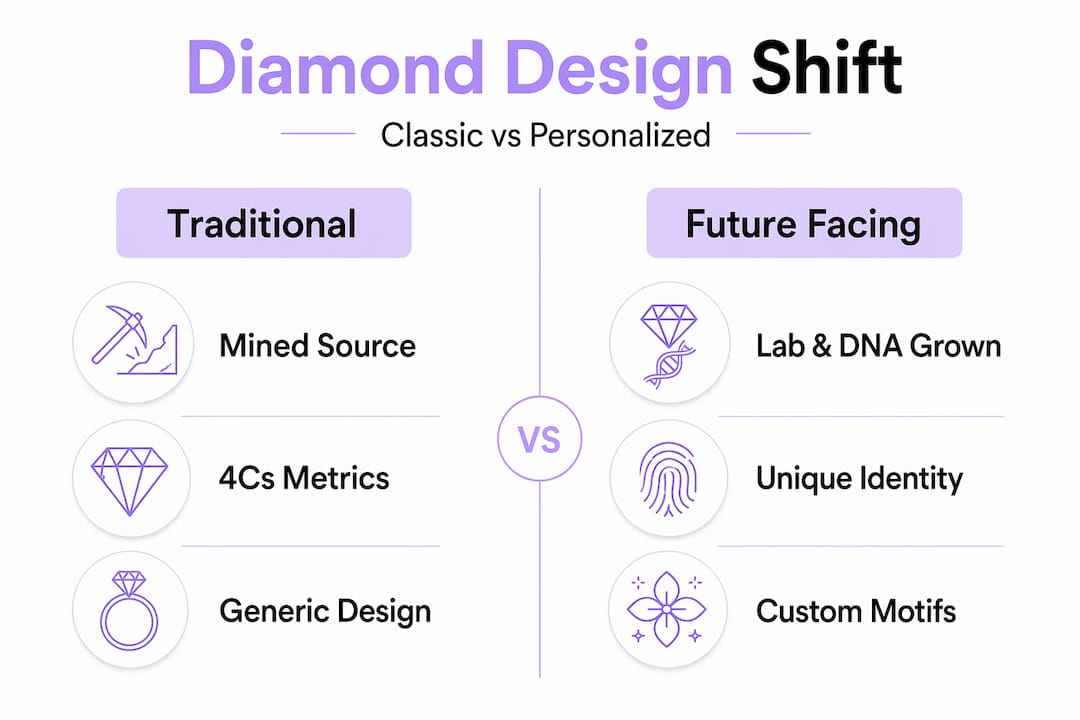
For collectors seeking personalized luxury gems that genuinely reflect identity, the future facing column is where the conversation now lives.
Personal DNA and memorial diamonds: Sentiment meets luxury
Moving from trends to actual applications, let’s explore the most powerful innovation in this space: DNA-based diamond creation.
The science is elegant in its simplicity. Carbon is the building block of every diamond. Human DNA, hair, and fingernails all contain carbon. When that carbon is extracted and purified to the correct grade, it becomes the feedstock for High Pressure High Temperature (HPHT) or Chemical Vapor Deposition (CVD) growth — the same processes used to grow premium lab diamonds. The result is chemically identical to a mined gem, except it is molecularly connected to a specific person.
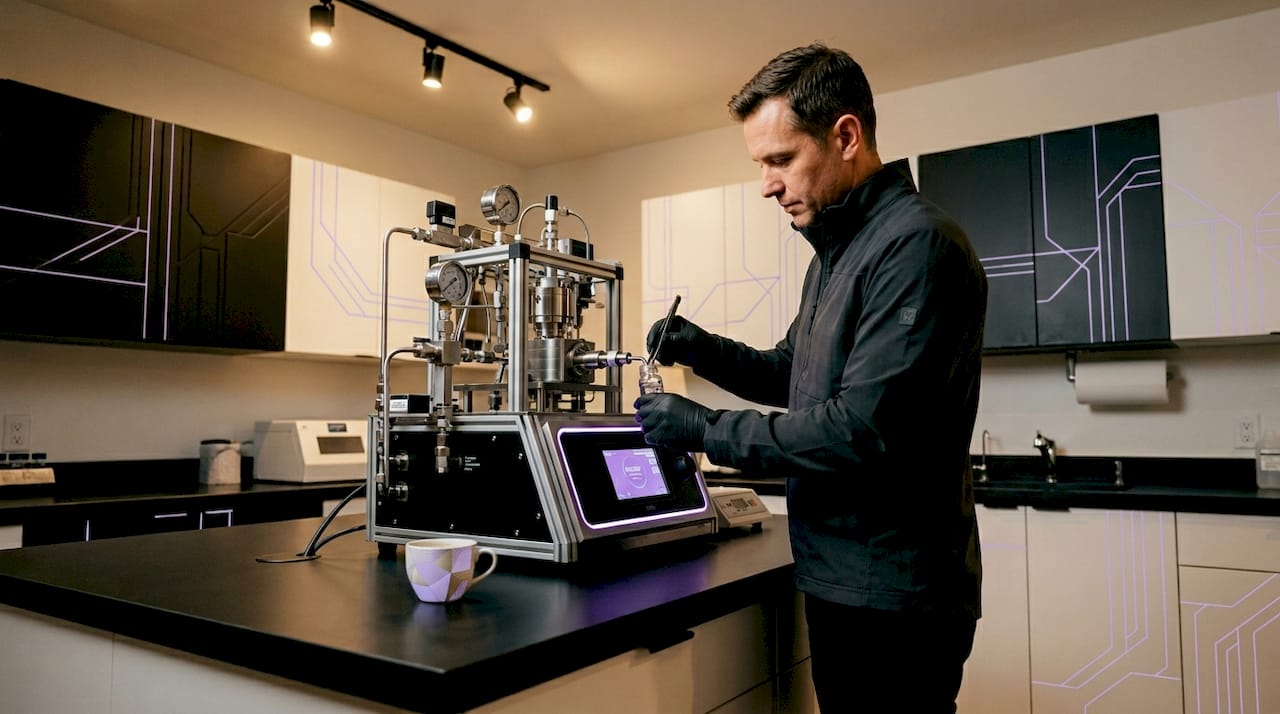
Memorial diamonds created from personal DNA or carbon sources like hair and ashes represent a pinnacle of personalized luxury jewelry, transforming sentimental elements into wearable gems with a depth of meaning that no mined stone can replicate. This is the memorial diamond creation guide framework that serious collectors are now exploring.
Here is how the DNA memorials process typically unfolds from start to finished gem:
Material collection: Hair, nails, or ashes are submitted in a small sample kit. Volume requirements are minimal.
Carbon extraction: DNA and organic matter are processed to isolate pure carbon.
Purification: Carbon is refined to the purity grade required for diamond growth.
Crystal growth: The purified carbon is placed in a growth chamber. HPHT or CVD conditions are applied.
Rough diamond formation: The crystal grows over several months into a rough stone.
Cutting and grading: A master cutter shapes the rough into the commissioned design.
Certification and delivery: The finished gem is certified and, if requested, embedded with an authenticity marker.
The data points worth knowing:
Specification | Detail |
Typical creation time | 6 to 10 months (traditional DNA diamond) |
Shineternity active processing | 2 hours (DNA from hair or nails into finished diamond) |
Sample material | Hair strands or nail clippings |
Final product | Certified, wearable diamond |
Color range available | Yellow, blue, colorless |
“The most significant shift in luxury jewelry is not the stone itself but what the stone carries. When a diamond holds your DNA, it stops being an accessory and becomes an artifact.” — Emerging consensus among luxury jewelry analysts
Pro Tip: If you are commissioning a memorial diamond for a loved one, collect multiple material samples and store them separately. This gives your jeweler flexibility if the primary sample yields insufficient carbon during extraction.
Design motifs: Futuristic DNA helix, exotic inlays, and advanced cuts
Now that we have covered DNA diamonds, let’s examine the visual innovations and rare motifs defining future luxury.
The DNA helix is arguably the most resonant structural motif in modern fine jewelry. DNA helix designs in jewelry mimic molecular structure using twisted bands or links, often with diamonds, meteorite, or exotic inlays for unique, futuristic personalization. The visual language of the double helix is immediately recognizable and carries an unmistakable message: this piece was built around biological identity, not catalog inventory.
Understanding DNA in diamond design means recognizing how motif and material reinforce each other. A helix band set with meteorite inlay communicates both cosmic scale and biological intimacy at the same time. That tension between the vast and the deeply personal is what makes future facing design so compelling to sophisticated collectors.
Beyond the helix, here are the design directions gaining serious traction in 2026:
Meteorite inlay: Iron-nickel meteorite (often Gibeon or Campo del Cielo) provides Widmanstätten patterns that are literally billions of years old and completely unrepeatable. No two slices look alike.
Dinosaur bone (gembone): Fossilized bone from prehistoric species, stabilized and polished, creates a setting material with 65+ million years of provenance.
Black ceramic and DLC coating: Diamond-like carbon coatings give settings a matte, industrial aesthetic that contrasts brilliantly with white diamonds.
Alexandrite and color-shift gems: Stones that change color under different lighting add a dynamic quality that shifts the piece across contexts.
On the cut side, the category has never been more innovative. Proprietary cuts like the LV Monogram Star (a 53-facet shape) and the JannPaul Marquise (137 facets) demonstrate that future facing design is also about engineering brilliance in ways that classic rounds and princess cuts simply cannot achieve. These cuts are designed to maximize light performance at specific angles, creating a visual identity as distinctive as a fingerprint.
Pro Tip: When selecting a motif, ask your designer to create a physical wax model before committing to the final piece. Helix structures in particular can look very different in three dimensions than they do in a rendering.
Authenticity and security: The rise of embedded DNA markers
With design originality established, it is essential to consider authenticity and security in the creation of future diamonds.
The counterfeiting problem in luxury jewelry is larger than most collectors realize. High-end pieces regularly enter repair cycles, estate transactions, and insurance claims where identity verification is critical. Traditional hallmarks and certificates can be separated from a piece or replicated. DNA cannot.
DNA authentication markers embedded in luxury jewelry materials provide forensic proof against counterfeits. Nano-DNA is integrated at the material level and verified via a 30-minute swab and qPCR test — a process accurate enough to hold up in legal proceedings. This is a fundamentally different category of proof than a laser inscription or a serial number.
Here is why understanding DNA marker tech matters for serious collectors:
Repair verification: Any piece sent for resizing, cleaning, or stone replacement can be re-authenticated on return.
Resale confidence: Secondary market buyers gain irrefutable provenance documentation, which directly supports valuation.
Insurance claims: Documented forensic identity makes disputed claims significantly easier to resolve.
Estate management: Heirs and estate managers can authenticate high-value pieces without relying on paperwork alone.
Anti-substitution: Confirms the original stone has not been swapped during a service appointment.
“Forensic authentication at the material level transforms a luxury piece from a beautiful object into a legally defensible asset — the distinction matters enormously when significant wealth is involved.”
It is worth separating two distinct uses of DNA in this context. Aesthetic DNA motifs like the helix band are a design choice celebrating biological identity. Embedded nano-DNA markers are a security technology ensuring physical authenticity. The best future facing pieces will often incorporate both, making them beautiful, personal, and irrefutably genuine.
Applying future facing design: Commissioning your bespoke DNA diamond
To move from concept to reality, let’s outline how you can commission your own personalized diamond using these future facing approaches.
The commissioning process for a future facing DNA diamond has more decisions than a standard bespoke commission. You are not just choosing a cut and a metal; you are making choices about source material, design philosophy, security features, and the story the piece tells. Approaching it with a clear framework saves time and ensures you get exactly what you envision.
Define the emotional narrative first. Before discussing cuts or metals, know what story the piece tells. Is it a memorial? A milestone? A celebration of self? That narrative drives every subsequent decision.
Select your source material. Hair and nail clippings are the most accessible DNA sources. If this is a memorial piece, ashes are also an option. Confirm with your jeweler how much material is required.
Choose your design motif. Helix bands, exotic inlays, and proprietary cuts each carry different visual vocabularies. Match the motif to the narrative.
Commission the cut. Work with your jeweler to select a facet pattern that maximizes brilliance for the intended setting and wearing context.
Specify authenticity features. Request nano-DNA marker integration alongside the standard certification. This protects the piece’s value across its entire life.
Plan for the timeline. The stepwise process for memorial diamonds traditionally spans 6 to 10 months from material submission to delivery.
The two-hour difference: Shineternity’s approach compresses active processing to approximately two hours by infusing DNA extracted directly from hair or nails into a finished diamond substrate. This does not eliminate the growth cycle for raw DNA diamonds, but it represents a fundamentally faster pathway for collectors who want a completed, personalized piece on a compressed schedule.
The personalization era rewards collectors who treat commissioning as a creative collaboration rather than a transaction. The more specifically you can articulate the meaning behind the piece, the more precisely your jeweler can translate that meaning into material form.
Our take: The real meaning behind future facing diamond design
For most of modern history, the diamond’s value story was built around scarcity. The rarer the stone, the more it was worth, and the more it communicated about its owner. That framework served its purpose, but it was always about external signaling rather than internal meaning.
We believe future facing design represents a genuine philosophical shift, not just a product category update. When a collector commissions a diamond grown from their own DNA, or from the carbon of someone they loved, they are stepping outside the external validation loop entirely. The piece does not need to signal anything to anyone. Its value is private, personal, and completely immune to market fluctuation.
Conventional wisdom would say that rarity is what makes a diamond precious. We would argue that the rarest thing a diamond can be is yours in a literal biological sense. No other person on earth can own that stone, because no other person shares that DNA. That is a category of exclusivity that even the most exceptional mined gem cannot offer.
Memorial diamonds are perhaps the clearest expression of this shift. They exist not to impress the room, but to carry something forward. They transform grief into permanence, or love into an artifact that outlasts the moment. Collectors who understand this are not buying jewelry. They are commissioning a physical record of something that mattered.
The future facing collector is not chasing the market. They are building a collection with personal logic that no trend can destabilize.
Next steps: Commission your custom diamond with Shineternity
Future facing design is not a concept confined to editorials and trade shows. It is available right now, and the process is more accessible than most collectors assume.
Shineternity works directly with clients who want a diamond that carries genuine personal meaning, from the molecular source through to the finished setting. Whether you are drawn to DNA infusion, helix motif design, exotic inlay work, or proprietary cuts, the custom jewelry design service at Shineternity is built to translate your vision into a piece that is both technically exceptional and emotionally resonant. The entire active process takes roughly two hours. The result lasts indefinitely. Book a consultation and start the conversation today.
Frequently asked questions
How is personal DNA used to create a diamond?
DNA is extracted from hair or nails, then the carbon is purified and either grown into a diamond through lab processes or infused into a finished stone, preserving a direct biological connection to the source. Memorial diamonds created from personal DNA or carbon sources represent the most personalized form of luxury jewelry available.
What makes DNA helix jewelry designs unique?
DNA helix jewelry replicates the molecular structure of the double helix in precious metal, often incorporating rare inlays like meteorite or exotic gems that amplify the futuristic and deeply personal character of the piece. Helix designs using twisted bands or links are recognized immediately as intentional statements of biological identity.
How does embedded DNA authentication work in luxury jewelry?
Nano-DNA markers are integrated directly into the jewelry material during creation, then verified with a 30-minute swab and qPCR test whenever authentication is required. DNA authentication markers provide forensic grade proof that stands up to legal and insurance scrutiny.
How long does it take to create a memorial DNA diamond?
Traditional lab grown DNA diamond processes typically require 6 to 10 months from carbon extraction to finished gem, while Shineternity’s infusion method compresses active processing to approximately two hours.
What are the benefits of commissioning a future facing diamond?
You receive a gem that is biologically unique, emotionally meaningful, and forensically authenticated, combining personal provenance with jewelry design trends 2026 that prioritize hyper-customization and emotional attachment over conventional status markers.
Recommended
Comments