Exquisite diamonds: your complete guide to meaningful gems
- Shineternity

- May 13
- 9 min read

You want to carry someone irreplaceable with you, not in memory alone, but in something you can hold, wear, and pass down. That desire is why memorial diamonds have captured the attention of discerning buyers who refuse to settle for ordinary keepsakes. Yet beneath the promise of transforming a loved one’s essence into a flawless, one-of-a-kind gemstone lies a landscape full of technical claims, emotional weight, and real controversy. This guide cuts through the noise to give you exactly what you need: a clear view of the process, an honest look at where questions arise, and a practical framework for making a decision worthy of the person you are honoring.
Table of Contents
Key Takeaways
Point | Details |
Process explained | The exquisite diamonds process involves transforming personal remains into a luxury gemstone using advanced technology. |
Controversy exists | There is ongoing debate about whether the carbon in memorial diamonds truly comes from the loved one’s remains. |
Due diligence is vital | High net worth buyers should carefully vet providers, ask for transparency, and verify all claims. |
Emotional meaning | The value of an exquisite diamond stems from personal intention and trust, not only technical process. |
Bespoke options available | Many providers offer custom jewelry experiences, from stone selection to ongoing consultation. |
What is the exquisite diamonds process?
At its most fundamental, the exquisite diamonds process describes the creation of a laboratory-grown diamond using carbon that has been isolated from a person’s remains. The emotional premise is as powerful as any in modern jewelry. Instead of a stone sourced from the earth with no personal connection, you receive a gem that is said to carry the actual molecular material of someone you loved.
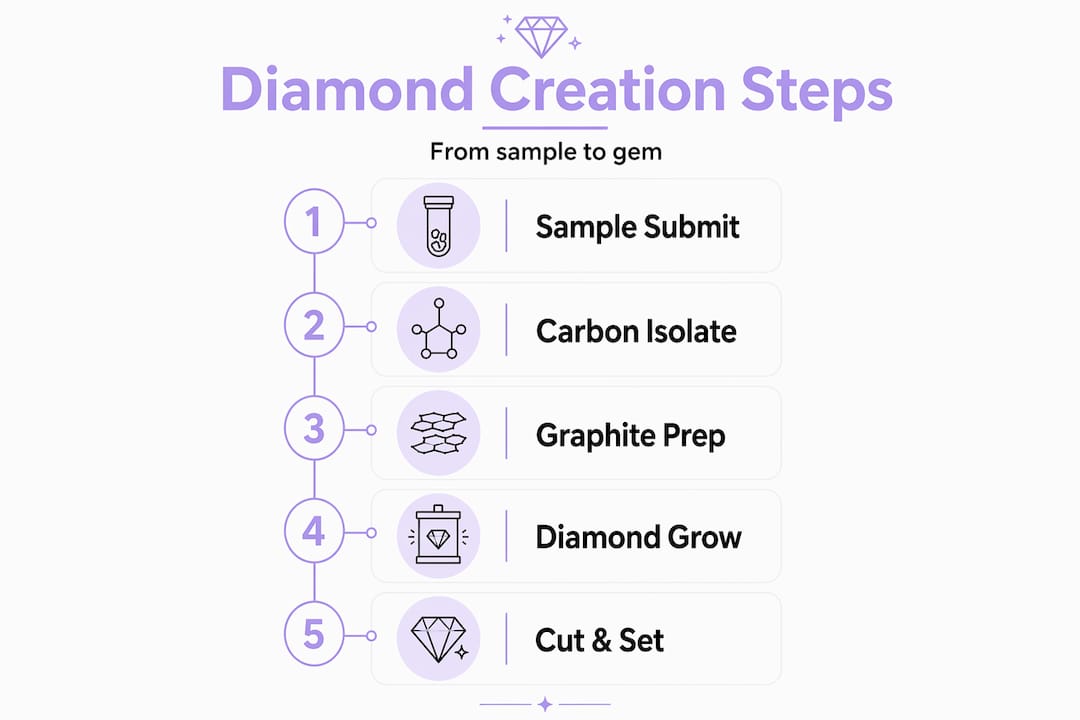
The foundational steps most providers describe follow a consistent arc. Remains — most commonly cremation ashes or, in some offerings, hair — are submitted to a process of carbon extraction. The isolated carbon is then converted into graphite, which serves as the feedstock for diamond growth under conditions that simulate what happens naturally deep inside the earth: extreme pressure paired with extreme heat. The result is a real, chemically identical-to-natural diamond, graded and cut to your specification.
Here is a simplified breakdown of those core steps:
Stage | What happens | Typical timeframe |
Sample collection | Ashes or hair submitted by family | Days 1 to 7 |
Carbon isolation | Medical-grade extraction of carbon | 1 to 2 weeks |
Graphite conversion | Carbon purified and converted | 2 to 4 weeks |
Diamond growth (HPHT) | High-pressure, high-temperature synthesis | 6 to 12 weeks |
Cutting and grading | Stone shaped, polished, and certified | 2 to 4 weeks |
Setting and delivery | Final jewelry piece assembled | 1 to 3 weeks |
The allure of intimate diamonds and DNA gemstones is that they claim to offer something no other luxury object can: a biological connection to a specific person. That promise commands premium prices, often ranging from several thousand to over twenty thousand dollars depending on carat, color, and complexity.

Here is where the controversy enters. A thorough investigative report has raised serious concerns that the carbon used to grow the final diamond may come from outside sources rather than from the deceased individual. That is not a minor footnote. It is a central question that every serious buyer must confront before committing.
Key claims made by providers typically include:
Personal carbon is the sole source of the diamond’s growth
Medical-grade processes ensure chain of custody is maintained
The final gem is chemically and emotionally unique
The stone carries the “essence” of the person memorialized
Each of these claims deserves scrutiny, which is exactly what the following sections provide.
Step-by-step: From personal remains to exquisite diamonds
Understanding each step in granular detail is the only way to ask the right questions when you sit down with a provider. Vague answers at any stage are a warning, not a reassurance.
Step 1: Submitting the sample Families typically send between 200 and 500 grams of cremation ashes, or a meaningful quantity of hair. Hair is preferred by some providers because it retains organic carbon more reliably than ashes, which undergo intense heat during cremation. The sample arrives in a sealed, labeled container, and a reputable provider logs it into a chain-of-custody system immediately upon receipt.
Step 2: Carbon isolation This is where the process becomes technically demanding. Ashes contain calcium phosphate as their primary compound, not carbon. Extracting usable carbon requires chemical processing under controlled laboratory conditions. Some providers claim yields of up to 99.99% pure carbon from this stage, though independent verification of those claims is rare.
Step 3: Graphite conversion Isolated carbon is refined into graphite, the crystalline precursor that feeds into the diamond growth chamber. Purity at this stage determines the quality of the final stone. Contaminants introduced here can affect color, clarity, and structural integrity.
Step 4: HPHT diamond growth High-Pressure High-Temperature synthesis is the same method used by leading diamond laboratories worldwide. Inside the growth chamber, temperatures exceed 1,400 degrees Celsius and pressures surpass 50,000 atmospheres. Over weeks, a diamond crystal forms around a seed, layer by layer. The final size depends on the growth duration.
Step 5: Cutting, grading, and personalization Once the rough diamond emerges, a master cutter shapes it according to your chosen specifications, whether a classic round brilliant, a distinctive cushion cut, or something entirely custom. The stone is then submitted for grading, ideally to an independent laboratory. This is where crafting branded diamonds with full documentation matters most, because a grading report is your portable proof of what you own.
Step 6: Setting The finished stone moves to a jewelry studio where it is set into your chosen piece, whether a ring, pendant, or another form. This is also the moment to ensure any personalized engraving or additional design elements are added.
Pro Tip: Before submitting any sample, request the provider’s chain-of-custody documentation in writing. Ask how they track your specific sample from receipt through growth and cutting. Any provider worth your trust will have a formal, auditable answer.
One uncomfortable reality: some investigations dispute the true origin of the diamond’s carbon, suggesting that the personal material may not be the actual source of the final gem. Understanding diamond quality customization from a technical perspective helps you ask sharper questions when evaluating these claims.
Truth and controversy: Is the personal carbon truly yours?
This is the hardest question in the entire memorial diamond category, and it deserves a direct, unvarnished answer.
“Skeptics argue that cremation-furnace conditions mean organic carbon is destroyed, and that diamonds may derive carbon from fuel sources rather than from the person being memorialized.” — Investigative Report on the Cremation Diamond Industry
The science behind this concern is real. A standard cremation chamber burns at temperatures between 760 and 980 degrees Celsius. At those temperatures, organic compounds, including the carbon-rich material in hair, skin, and tissue, are largely oxidized. What remains is predominantly calcium phosphate and bone mineral. The carbon that survives in usable form for diamond synthesis may be far less than providers suggest.
Here is a comparison of how providers frame the process versus what critics have documented:
Dimension | Provider claims | Investigative findings |
Carbon source | 100% personal remains | Possible fuel or external carbon contamination |
Process purity | Medical-grade, fully traceable | Chain of custody often unaudited |
Carbon yield | Sufficient for full diamond growth | Organic carbon largely destroyed during cremation |
Emotional authenticity | Stone contains loved one’s essence | Scientific basis for this claim is disputed |
Transparency | Full documentation provided | Many providers lack independent verification |
What should a discerning buyer take from this? Not necessarily that every provider is being dishonest. The more likely reality is a spectrum: some providers maintain rigorous processes with genuine personal carbon contribution, while others operate with far less rigor and transparency.
The key warning signs to watch for:
Claims of 100% personal carbon with no independent verification offered
Refusal to explain the chemical process in any detail
No formal chain-of-custody documentation
Pressure to decide quickly without time for due diligence
Exploring options in bespoke luxury and DNA gems shows that some providers are pushing the industry toward greater transparency by using DNA-based personalization rather than relying solely on carbon extraction from ashes, which sidesteps many of the contamination concerns entirely. If gem authenticity concerns are paramount to you, this is a direction worth exploring seriously.
Selecting an artisan: What to ask, what to expect
Given everything outlined above, the choice of provider carries enormous weight. This is not a category where you should let price alone guide your decision. The commercial and ethical dimensions of this industry challenge the trust buyers extend to diamond makers, and that trust must be earned through verifiable transparency.
Here is a practical checklist for evaluating any provider:
Ask for the chain of custody in writing. Every handoff of your sample, from shipping to lab intake to growth chamber to cutter, should be documented. Ask for the specific format they use and who reviews it.
Request independent grading. Any finished stone should come with a report from a recognized independent grading laboratory, not just the provider’s own certificate.
Inquire about carbon sourcing specifically. Ask directly: “Can you show me documentation that confirms the carbon in my diamond originated from the sample I provided?” Watch for vague or defensive answers.
Ask about third-party audits. Reputable providers in this space will welcome external scrutiny. Those who avoid it rarely have good reasons for doing so.
Understand the process for DNA-based personalization. Providers who incorporate actual DNA markers into the diamond creation process offer a potentially more scientifically grounded form of personalization than those relying solely on carbon from cremation ashes.
Verify return policies and guarantees. If a provider cannot explain what happens if you are unsatisfied, that tells you something important about how they view the relationship.
Pro Tip: Before any consultation, prepare a list of five specific technical questions. A provider confident in their process will answer each one without hesitation. A provider who pivots to emotional marketing language when asked for technical detail is a provider to approach with caution.
When researching personalized luxury gems, pay particular attention to how providers discuss what happens if the carbon yield from your sample is insufficient. This is a revealing moment. A transparent provider explains the backup plan clearly. A less honest one glosses over the question entirely.
Beyond the legacy: Why meaning and process must go hand in hand
Here is an opinion formed through direct experience in the personalized jewelry space: the memorial diamond industry has allowed emotional marketing to outpace scientific accountability, and buyers are sometimes left with beautiful stones and genuine uncertainty about what those stones actually contain.
That is a problem, but it is not an unsolvable one. The answer is not to dismiss the entire category. The desire to carry a loved one in a lasting, wearable form is real, legitimate, and deeply human. What needs to change is the standard of transparency that buyers demand and that providers must meet.
We believe the most meaningful memorial diamonds come from processes where the buyer is fully informed at every stage, not just comforted with beautiful language about legacy and essence. When you understand how your stone was made and can verify that the process was executed as promised, the emotional value actually increases. You are not relying on a claim. You are honoring a fact.
The shift toward DNA-infused personalization, where actual genetic material from hair or nails is incorporated into a finished diamond in a documented, verifiable process, is a significant step forward. It addresses many of the concerns around carbon sourcing while preserving and even enhancing the personal connection. A diamond carrying DNA is connected to a living biological record of who that person was, not just a residual carbon trace that may or may not have survived the cremation process.
The most important advice we can offer is this: crafting gems that matter requires you to participate actively in the process. Ask questions. Expect answers. Insist on documentation. The most extraordinary memorial diamond you can own is one you fully understand, because that understanding becomes part of the story you tell about the person it honors.
Craft your legacy with confidence
You have done the hard work of understanding this process in full. Now comes the most rewarding part: turning that knowledge into something extraordinary.
At Shinlabz, we specialize in infusing DNA extracted from hair or nails directly into a finished diamond, a process that takes just two hours and produces a gemstone with a verified, documented personal connection. There are no ambiguous carbon claims, no chain-of-custody gaps, and no room for doubt. Our team brings together luxury craftsmanship and scientific precision so that your diamond is as meaningful as the person it represents. Explore our custom jewelry design options or book a consultation to begin designing a piece that carries genuine meaning.
Frequently asked questions
Is the carbon in an exquisite memorial diamond actually from my loved one?
The answer depends entirely on the provider and process. Investigations into carbon origin have found that fuel-source contamination and carbon loss during cremation may undermine this claim, which is why demanding documented verification is essential before purchasing.
How can I be sure I’m choosing a reputable diamond maker?
Ask for chain-of-custody documentation, independent grading reports, and a clear explanation of their carbon sourcing. The commercial and ethical scrutiny facing this industry means that transparency is your single most reliable signal of a trustworthy provider.
What should I look for in the finished diamond to ensure it’s genuine?
Request a grading certificate from an independent gemological laboratory, full process documentation, and any DNA or carbon sourcing records the provider maintains. A certificate issued solely by the creating company carries far less weight than one from a recognized third party.
Are there alternative ways to personalize a diamond besides using personal remains?
Absolutely. DNA infused from hair or nails, engraving with initials or meaningful dates, choosing a specific color that held significance to your loved one, and selecting a custom cut shape are all powerful ways to create personal meaning without relying on the contested carbon extraction process.
Is the exquisite diamonds process controversial?
Yes, significantly so. Ongoing controversy about sourcing centers on whether the final diamond genuinely contains personal carbon from the deceased or whether that carbon may come from external sources, and the industry has not yet established universal standards to resolve the debate.
Recommended
Comments