Diamond technology breakthroughs for luxury jewelry


For centuries, the diamond sitting in a ring or pendant owed everything to chance: where it formed deep in the earth, how it traveled upward through volcanic pipes, and whether it survived the journey intact. That randomness defined rarity, and rarity defined luxury. That equation is now being completely rewritten. Scientists are synthesizing new diamond structures, growing inch-scale stones with engineered precision, and shaping them with lasers and magnetic fields, giving collectors and jewelry lovers a level of control over their diamonds that was simply unimaginable a generation ago.
Table of Contents
Key Takeaways
Point | Details |
Next-generation diamond growth | Advanced synthesis achieves larger, purer, and ultrahard diamonds for luxury and custom use. |
Extraordinary customization | Precision shaping and engineering enable bespoke jewelry with tailor-made size, cut, and features. |
Luxury meets technology | Breakthroughs allow collaboration between science and design, creating personalized luxury gems. |
Cutting-edge applications | Engineered diamonds are now used in both high-end jewelry and advanced technical devices. |
What drives breakthroughs in diamond technology?
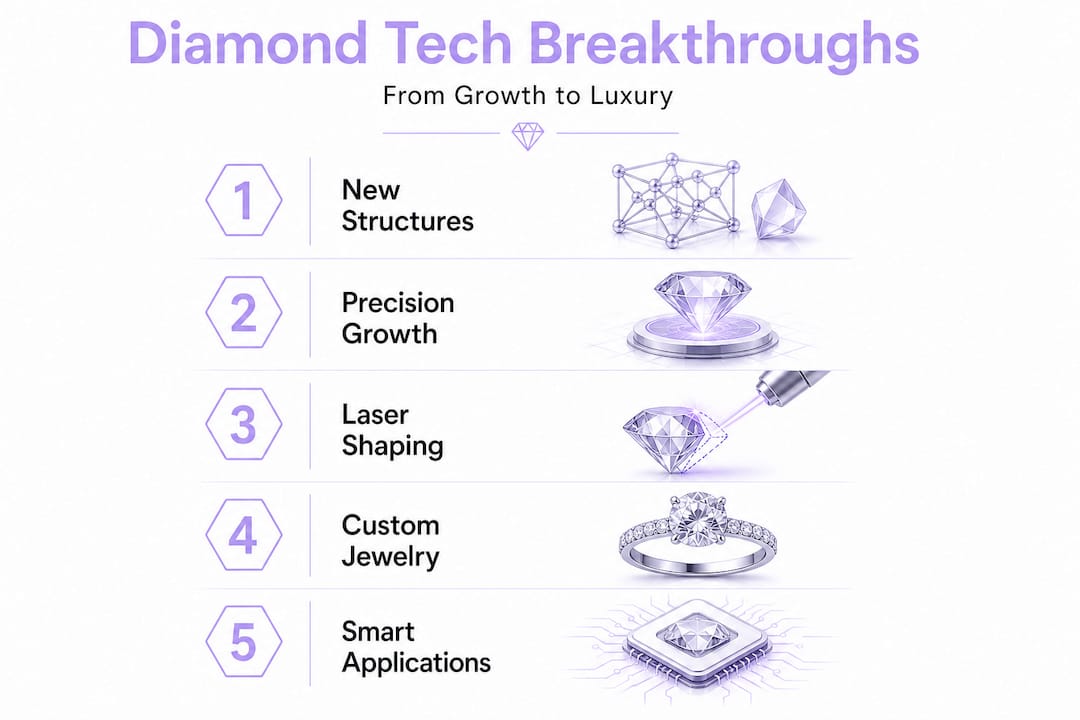
Diamond innovation is happening across three interconnected fronts: new crystal structures, refined growth methods, and deliberate defect engineering. Each breakthrough feeds into the others, and together they are expanding what a diamond can be, both physically and symbolically.
Traditional luxury has always leaned on natural diamonds, prized for their cubic crystal structure, optical fire, and geological rarity. Lab-grown diamonds using High Pressure High Temperature (HPHT) and Chemical Vapor Deposition (CVD) methods have already disrupted the market by offering chemically identical stones without the supply chain uncertainty. But the newest research goes further still.
Scientists have now synthesized bulk hexagonal diamond as millimeter-sized, phase-pure material with high hardness and thermal stability. This material, also called lonsdaleite, has a different atomic arrangement than the cubic diamonds worn in rings today. It is harder, more thermally stable, and was once only found in trace amounts inside meteorite impact craters. Today it can be made deliberately in a lab. While lonsdaleite remains science-oriented for now, it is the clearest proof yet that diamond science is no longer bound by what nature happens to produce.
Diamond type | Crystal structure | Primary source | Hardness | Custom potential |
Natural cubic | Cubic | Mined | 10 Mohs | Limited |
Lab-grown CVD | Cubic | Reactor grown | 10 Mohs | High |
HPHT synthetic | Cubic | Press grown | 10 Mohs | High |
Lonsdaleite | Hexagonal | Lab synthesized | Exceeds cubic | Emerging |
For buyers focused on diamond quality factors, these developments matter enormously. They shift the value conversation from geological luck to engineered excellence, where the characteristics of your diamond can reflect deliberate choices rather than the arbitrary conditions millions of feet underground.
Key drivers shaping this era include:
New crystal phases that deliver properties beyond cubic diamonds
Advanced CVD reactors capable of growing larger, purer stones faster
Defect engineering to tailor hardness, color, and optical performance
Precision characterization tools that detect and control impurities at the atomic level
Pro Tip: When evaluating a custom diamond, ask specifically whether the grower uses defect-engineered CVD protocols. This is the clearest indicator that you are working with a maker who treats diamond creation as a craft, not a commodity.
With this context in mind, let’s look at the tangible size and purity advances that are enabling a new era of personal luxury.
Innovative diamond growth: From millimeter hexagonal to inch-scale wafers
The scale of what is now possible in diamond growth would have seemed like science fiction even a decade ago. For context, most jewelry-grade lab-grown diamonds have historically been limited in size by the slow pace of crystal growth and the difficulty of maintaining purity across larger surfaces. That bottleneck is being broken.
Defect-engineered CVD approaches now produce wafer-sized ultrahard diamonds exceeding 208.3 GPa in hardness. To put that number in perspective, standard natural diamond hardness is measured at roughly 100 GPa under similar testing conditions. These new CVD wafers are not just bigger; they are structurally superior because defect engineering allows makers to place, control, or eliminate specific atomic irregularities that would otherwise weaken the stone or limit its optical clarity.
This changes custom jewelry on a practical level in several ways:
Larger center stones become feasible without sacrificing the internal purity that defines a premium gem.
Complex custom cuts that would previously crack or chip during fabrication are now achievable because the underlying crystal is stronger and more uniform.
Color engineering becomes more precise, since controlling defects also controls how the diamond interacts with light at specific wavelengths.
Longer polishing sequences can be applied without degrading the stone, meaning final surface quality is significantly improved.
Consistent production allows jewelers to plan and design around predictable material specs, rather than working around whatever nature delivered.
Growth method | Typical output size | Hardness range | Best application |
Traditional HPHT | Up to 10 carats | ~100 GPa | Classic luxury stones |
Standard CVD | Up to 15 carats | ~100 GPa | Custom and colorless gems |
Defect-engineered CVD | Wafer scale | 208+ GPa | Ultra-custom, precision jewelry |
Understanding the stepwise diamond creation process makes it clearer why these advances matter for bespoke commissions. Each phase of growth, from seed crystal selection to final reactor conditions, now offers deliberate control points that a skilled maker can use to dial in specific properties. If you are commissioning custom diamonds for a significant piece, these are the conversations worth having with your jeweler before a single facet is cut.
Growth breakthroughs set the stage, but shaping raw diamond into jewels of distinction requires equally sophisticated precision.
Cutting-edge diamond shaping: Laser and multi-energy precision
Growing a structurally superior diamond is only half the equation. Transforming that rough material into a finished gem without introducing new flaws or surface damage is where fabrication science becomes just as important as growth science. Fortunately, the tools available for shaping diamonds are advancing at the same rapid pace.
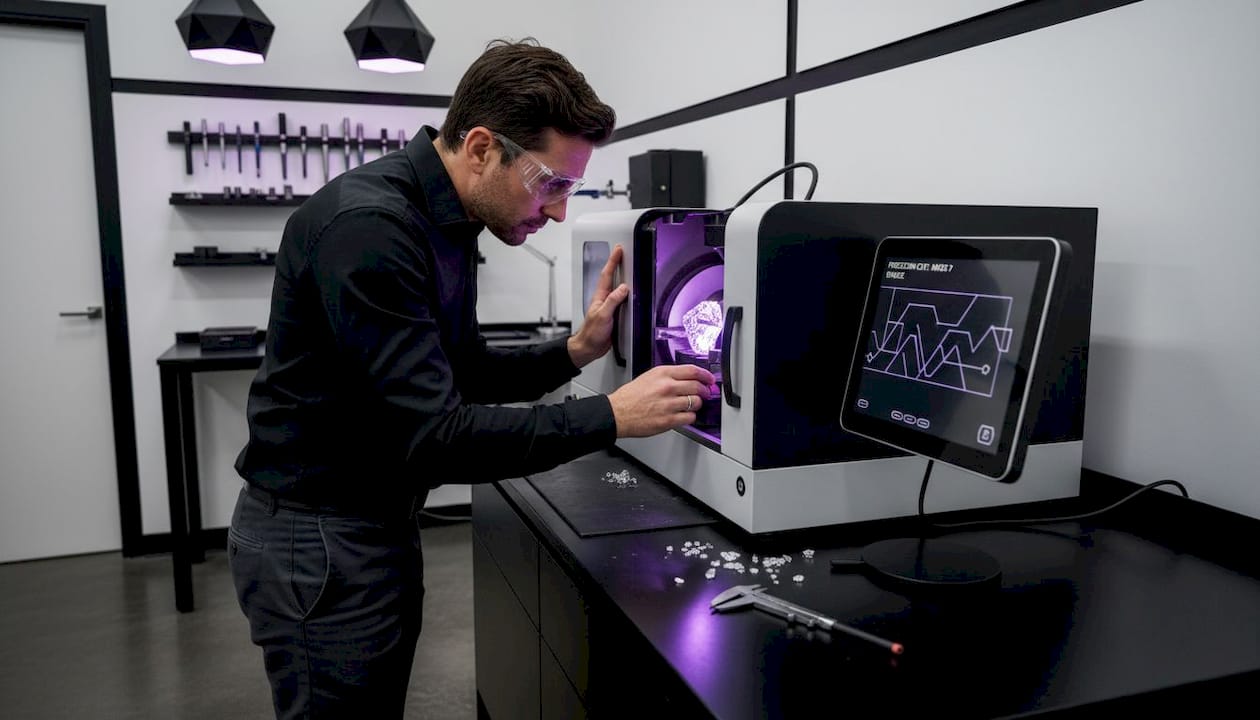
Laser-assisted diamond turning reduces fabrication damage and improves surface integrity compared to conventional mechanical cutting. Traditional diamond cutting relies on physical contact between cutting tools and the stone, which introduces micro-fractures and surface stress. Laser assistance allows much of the material removal to happen thermally, with far more control over where and how aggressively material is removed. The result is smoother facets, sharper edges, and a finished surface that scatters light more evenly.
But the most impressive recent development combines more than one energy source. Multi-energy cutting using both laser and magnetic field assistance delivers smoother surfaces and less tool wear than either method alone. Magnetic field assistance stabilizes the cutting process at a microscopic level, reducing vibration and improving the consistency of each pass. When both methods are used together, the quality improvement is substantial enough to unlock cuts and surface geometries that were previously too risky to attempt on high-value stones.
For luxury buyers, the practical advantages include:
Fewer surface inclusions introduced during fabrication, meaning a cleaner final stone
Greater design freedom for unusual or asymmetric cuts that require very precise material removal
Optical effects from perfectly smooth facets that interact with light differently than conventionally cut stones
Thinner finished profiles that allow for lower-profile settings without compromising structural integrity
The finest luxury piece is not just about the raw material. It is about how that material is shaped, controlled, and finally presented. Advanced fabrication methods are now giving artisans the same precision advantage that advanced growth methods gave diamond growers.
Pro Tip: When commissioning custom diamonds with unusual or avant-garde cuts, specifically ask whether your maker uses laser-assisted or multi-energy fabrication. Conventional cutting tools simply cannot achieve the same precision on complex geometries, and the difference in final quality is visible. This is also worth exploring when you want to craft branded diamonds with signature surface features.
With these precision techniques, diamonds not only dazzle but perform new roles in both jewelry and technology.
Diamonds for high-tech luxury: Engineered devices and custom applications
One of the most startling developments in diamond technology has nothing to do with sparkle. Engineered diamonds are now performing roles in high-power electronic systems, proving that this material is moving far beyond its traditional domain.
Engineered diamond RF limiters handled over 100 Watts and set new device performance records in collaboration between Advent Diamond and Northrop Grumman. RF limiters are components that protect sensitive electronics from signal overloads, and having them made from engineered diamond means they can handle extreme power while staying cool. That thermal management capability is one of diamond’s most remarkable physical properties, and it is now being exploited in precision engineering contexts far outside jewelry.
Why does this matter for a luxury buyer? The same engineering culture that produced these high-performance devices is directly applicable to jewelry with functional ambitions. Consider what these technologies open up:
Thermally superior settings where engineered diamond components help protect sensitive embedded elements in bespoke wearables
Custom optical components such as lenses or prisms integrated into statement pieces for unique visual effects
Wearable art that incorporates technology, including pieces where a central engineered diamond interacts with light, temperature, or electrical charge in designed ways
Provenance and traceability features embedded at the atomic level through deliberate impurity placement
The bridge between personalized luxury gems and engineered performance is closer than it seems. And for collectors who want something no one else on earth owns, a bespoke DNA diamond takes that personalization to its most literal extreme: your own genetic signature, captured in a finished stone in under two hours.
Pro Tip: The next wave of truly distinctive luxury pieces will likely involve diamonds that do something beyond looking beautiful. If you are building a serious collection, pay attention to functional diamond innovations now, because they will define the most coveted pieces of the next decade.
Understanding these scientific frontiers gives new meaning to what luxury and personalization can actually mean in this era.
Why breakthrough diamond technology matters for luxury jewelry buyers
There is a tempting way to frame the current moment in diamond technology: as a story about science overtaking nature. But that framing misses the deeper point, and frankly, it underestimates what this shift means for the people who care most about extraordinary jewelry.
Traditional luxury was always built on scarcity. The finest natural diamonds were prized because no two were exactly alike, and you could not order a replacement if yours was lost. The emotional power of that scarcity was real, but it was passive. You accepted what nature produced. You had no say in the outcome.
What is happening now is fundamentally different. It is not that technology is replacing nature’s prestige. It is that technology is giving clients active authorship over the most intimate objects they will ever own. When a diamond can carry your DNA, reflect a custom-engineered optical signature, or be cut to a geometry that has never existed before, the conversation about rarity changes entirely. The rarest thing in the world is not a geological accident. It is something made specifically for you, by someone who understands both the legacy of the craft and the frontier of the science.
Our perspective, built through working at the intersection of these two worlds, is that the buyers who will get the most from this era are those who resist the passive collector mindset. The collectors who will own the most meaningful pieces in ten years are the ones asking their jewelers hard questions today: What growth method did you use, and why? What fabrication techniques did you apply, and what options did you consider? Can I have my own biological signature personalized into DNA gems embedded in this stone?
Legacy craftsmanship will always matter. The eye of an experienced setter, the judgment of a master cutter, the sensibility of a great designer: none of that is going away. But the tools those craftspeople now have access to are extraordinary. The clients who treat diamond technology as an invitation to collaborate rather than a technical detail to outsource will end up with pieces that are genuinely irreplaceable, not because nature made them that way, but because they chose to make them that way.
Ready to create your own breakthrough luxury diamond?
The science is moving fast, and the possibilities it opens for bespoke diamond jewelry are genuinely exciting. But reading about it and doing something with it are two different things.

At Shinlabz, we work at exactly this intersection: advanced diamond technology and deeply personal luxury. Whether you want to explore the latest precision growth methods, commission a custom cut that takes full advantage of laser-assisted fabrication, or capture your DNA in a finished diamond in under two hours, the starting point is a real conversation about your vision. Our custom jewelry design process is built around your specifics, not a catalog. If you are ready to move from inspiration to creation, book a design consultation and let’s talk about what your diamond can actually be.
Frequently asked questions
How do technological breakthroughs impact the quality of luxury diamonds?
Innovative growth and shaping techniques now yield diamonds with improved clarity, larger sizes, and tailored features ideal for bespoke luxury jewelry. Defect-engineered CVD methods produce larger, ultrahard diamond wafers that set a new standard for high-end applications.
What is the difference between hexagonal and traditional cubic diamonds?
Hexagonal diamond (lonsdaleite) is a newly synthesized structure with higher hardness and thermal stability than traditional cubic diamonds, though it is currently found mainly in scientific settings. Bulk hexagonal diamond offers measurably higher hardness than standard cubic diamonds under equivalent testing conditions.
Can advanced diamond manufacturing enable truly unique custom jewelry?
Yes, the latest precision cutting and defect-engineered growth methods allow custom cuts, sizes, and even functional features in luxury pieces. Laser and multi-energy cutting enables smoother surfaces and creative design freedom that conventional fabrication simply cannot match.
What future potential do engineered diamonds hold for luxury markets?
Engineered diamonds are expanding luxury options by offering new aesthetics and integrating high-performance functions into jewelry and wearable art. Engineered diamond RF limiters demonstrate advanced device performance that points directly toward luxury technology integration in the years ahead.
Recommended
Comments