Diamond quality factors explained: customize the perfect gem

Most people assume the biggest diamond in the room is automatically the best. That assumption costs luxury buyers thousands of dollars and, more importantly, leaves them with a stone that fails to capture the light, the eye, or the imagination. True diamond quality is a layered story told by four interlocking factors, and understanding each one gives you the power to commission something genuinely extraordinary. Whether you are selecting a statement piece or considering a personalized DNA-infused gem, mastering these fundamentals transforms a purchase into a legacy.
Table of Contents
Key Takeaways
Point | Details |
Cut is king | The cut grade has the greatest impact on brilliance and overall presence. |
Balance value factors | Choosing VS2-SI1 clarity and the right color offers rarity and beauty without overpaying. |
Certification matters | AGS Ideal and GIA Excellent provide different standards—understand what’s behind your report. |
Customization elevates luxury | Personal DNA and expert design turn a quality diamond into a truly unique legacy piece. |
The four Cs: Foundation of diamond quality
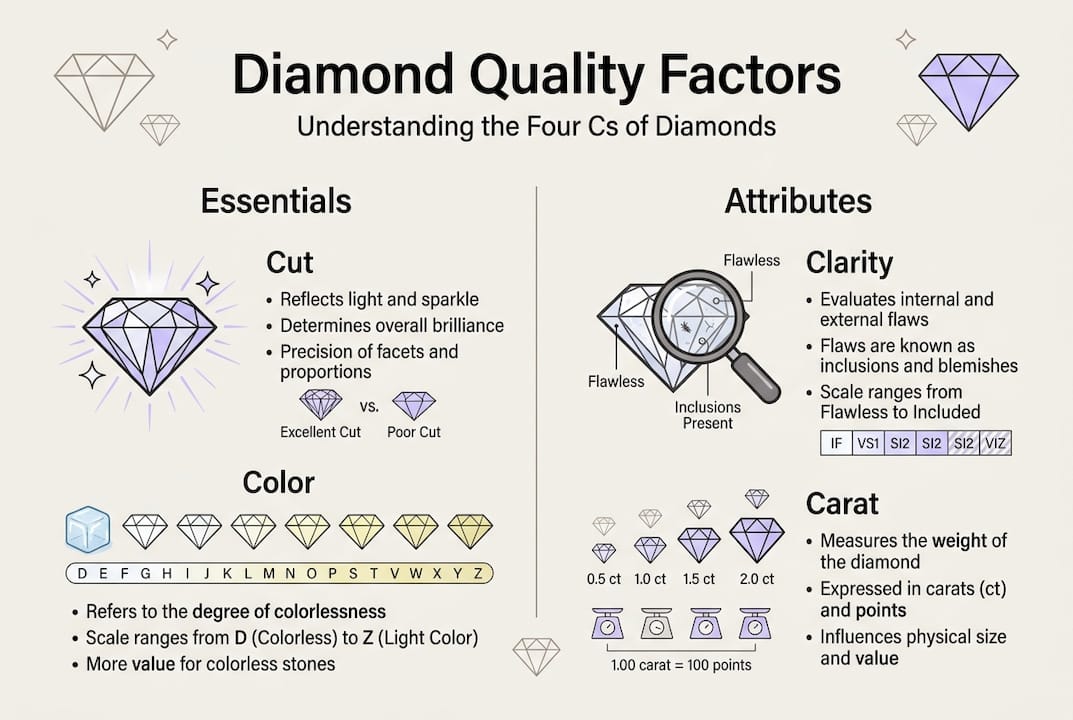
Every diamond in the world is evaluated on the same four criteria: cut, color, clarity, and carat. These are not arbitrary marketing categories. They are precise, internationally recognized quality benchmarks developed by the Gemological Institute of America (GIA) and adopted by every serious jeweler, auction house, and collector on the planet. For anyone commissioning a custom or personalized diamond, understanding these factors is not optional. It is the foundation of every decision you will make.
Cut is the single most powerful factor in determining how a diamond looks and performs. It governs how light enters the stone, bounces between facets, and exits back through the top in a burst of brilliance and fire. A poorly cut two-carat diamond will look dull and lifeless next to a perfectly cut one-carat stone. Cut determines brilliance, fire, and scintillation, making it the factor that separates a remarkable diamond from a forgettable one.
Color in a diamond refers to the absence of color. The GIA grades diamonds on a D-to-Z scale, where D is completely colorless and Z carries a visible yellow or brown tint. For luxury buyers, the sweet spot typically sits between D and H, where the stone appears icy and bright to the naked eye. Colorless diamonds (D-F) command premium prices because of their rarity.
Clarity measures the presence of internal characteristics called inclusions and surface features called blemishes. A flawless diamond is extraordinarily rare and priced accordingly. Most luxury buyers find that a VS1 or VS2 grade delivers a visually perfect stone without paying the premium for flawless.
Carat is the unit of weight, not size, though the two are related. One carat equals 0.2 grams. Here is the key insight most buyers miss:
A 1.5-carat diamond with an exceptional cut will outshine a 2-carat diamond with a mediocre cut every single time. Carat is a status number. Cut is a beauty number.
The smartest approach blends all four factors strategically:
Prioritize cut above all else for visual impact
Choose color in the D-H range for luxury appeal
Select VS1-VS2 clarity for a clean, investment-grade stone
Choose carat weight last, after the other three are locked in
For collectors pursuing truly one-of-a-kind pieces, these principles apply with even greater force because the diamond must be worthy of the story it carries.
Cut grades: Beyond GIA Excellent and AGS Ideal
Once you accept that cut is paramount, the next question becomes: which cut grade is actually good enough? This is where the conversation gets more nuanced, and where many buyers make expensive mistakes.
The GIA grades cut on a five-tier scale: Excellent, Very Good, Good, Fair, and Poor. Most luxury buyers aim for GIA Excellent, which sounds definitive. The problem is that GIA Excellent is broad compared to the more rigorous AGS Ideal standard, meaning two diamonds can both carry a GIA Excellent grade while performing very differently in terms of light return and visual beauty.
The American Gem Society (AGS) uses a 0-10 scale, where 0 is Ideal. AGS Ideal demands tighter tolerances on proportions, symmetry, and polish, resulting in measurably superior light performance. For bespoke luxury diamonds where every detail must be extraordinary, AGS Ideal is the benchmark worth pursuing.

Grade | System | Light performance | Best for |
Excellent | GIA | High, but variable | Premium jewelry |
AGS Ideal (0) | AGS | Consistently exceptional | Investment and custom pieces |
Very Good | GIA | Good, minor leakage | Value-focused buyers |
Good | GIA | Moderate leakage | Budget-conscious choices |
When reading a grading report, look beyond the headline grade. Check the polish and symmetry sub-grades, both should be Excellent or Ideal. Review the depth percentage (ideally 59-62.5% for round brilliants) and the table percentage (ideally 54-58%). These numbers tell you whether the cutter prioritized beauty or weight retention.
The best diamond cutters sacrifice rough material to achieve perfect proportions. A cutter who chases carat weight at the expense of angles is not serving the stone.
Pro Tip: If you are commissioning a custom jewelry design, specify AGS Ideal or GIA Excellent with Excellent polish and symmetry as a minimum requirement in your brief. This single instruction will elevate the final piece significantly.
Light leakage, which occurs when light exits through the sides or bottom of the stone rather than back through the top, is invisible on a grading certificate but immediately visible in person. Always view a diamond under multiple lighting conditions before finalizing any commission.
Clarity, color, and carat: How to balance rarity and beauty
Cut is the engine. Clarity, color, and carat are the variables you tune to achieve the perfect balance of beauty, rarity, and investment value. The good news is that strategic choices here can free up budget for a better cut or a more meaningful customization.
For clarity, the VS2-SI1 range is widely recognized as the sweet spot for eye-clean diamonds that offer strong value. An eye-clean stone has no inclusions visible to the naked eye at normal viewing distance, which means it looks flawless in everyday wear. However, this guidance shifts depending on the diamond’s shape. Step-cut diamonds like emerald and Asscher cuts have large, open facets that act like windows into the stone, making inclusions far more visible. For step cuts, VS1 or even VVS2 is a smarter starting point.
Shape | Recommended clarity | Reason |
Round brilliant | VS2-SI1 | Brilliant facets hide inclusions well |
Emerald / Asscher | VS1-VVS2 | Open facets reveal inclusions easily |
Oval / Pear | VS2-SI1 | Moderate masking from facet pattern |
Cushion | VS2-SI1 | Good inclusion masking |
For color, luxury buyers rarely need to go below G-H for a white appearance, especially in white gold or platinum settings that reflect colorlessness back into the stone. Yellow gold settings, on the other hand, can mask slight warmth, allowing you to choose an I-J color without any visible compromise.
Carat weight is where buyers most often overspend. Consider these strategic trade-offs:
A 0.90-carat stone costs significantly less than a 1.00-carat stone with identical quality, yet the visual difference is imperceptible
Fancy shapes like ovals and pears often appear larger per carat than rounds
Shallow cuts can inflate apparent size while destroying brilliance
Pro Tip: Use the exclusive diamond checklist to map out your priorities before speaking to any jeweler. Knowing your non-negotiables in advance prevents upselling and keeps your focus on genuine quality. Your personal DNA diamond guide can also help align these choices with the story you want the stone to tell.
Personalization: Elevating diamond quality through DNA and design
Mastering the four Cs is not just an academic exercise. It is the gateway to commissioning a diamond that carries meaning no off-the-shelf stone can replicate. For collectors who want a piece that is genuinely irreplaceable, DNA customization represents the pinnacle of personalized luxury.
Here is why quality factors are non-negotiable when personalizing a diamond. A DNA-infused stone is, by definition, one of a kind. Its uniqueness is already secured by provenance. The quality grades are what ensure it is also one of the most beautiful diamonds in any room. A meaningful gem with a mediocre cut is a missed opportunity. A meaningful gem with an AGS Ideal cut is an heirloom.
The stepwise diamond creation process for a DNA-infused diamond moves through clear, deliberate stages:
DNA extraction from hair or nail samples, completed within the two-hour appointment
Quality specification where cut, color, clarity, and carat are selected to match your vision
Diamond selection from certified inventory matching your exact grade requirements
DNA infusion into the finished diamond, permanently bonding your biological signature to the stone
Setting design chosen to complement the diamond’s shape and proportions
Final grading review to confirm all specifications are met before delivery
For GIA Excellent or AGS Ideal cut diamonds used in personalized pieces, the quality investment is justified precisely because the stone will be worn, admired, and passed down. Quality that lasts generations is not an extravagance. It is the point.
Key checklist for your personalized diamond:
GIA or AGS certification confirmed
Cut grade: GIA Excellent or AGS Ideal
Color: D-H for white metals, D-J for yellow gold
Clarity: VS1 or better for step cuts, VS2-SI1 for brilliants
Carat: chosen after all other factors are locked
DNA infusion documented and certified
Why most diamond buyers overlook what truly matters
After years of working with discerning collectors and gift-givers, one pattern repeats itself constantly. Buyers walk in focused on carat weight and walk out disappointed when the stone does not perform the way they imagined. The fixation on size is understandable. Carat is the one number everyone knows, the one that sounds impressive at a dinner table. But it is also the least reliable predictor of a diamond’s actual beauty.
The leap in visual quality between a well-cut one-carat stone and a poorly cut 1.5-carat stone is not subtle. It is dramatic. And once you see it, you cannot unsee it. The buyers who understand this do not chase weight. They chase light.
Personalized gems become true heirlooms precisely because their quality and provenance are both understood and documented. When you can say “this stone carries my DNA, it is graded AGS Ideal, and it was designed for this specific setting,” you are describing something that no secondary market can replicate. That combination of quality and story is what separates a premium custom diamond from a commodity purchase. Market trends shift. Carat preferences change. A diamond built on mastered quality fundamentals and a personal story remains extraordinary in any era.
Experience bespoke luxury: Design your own diamond keepsake
You now have the framework to commission a diamond that performs as beautifully as it means something. The next step is putting that knowledge to work with a team that specializes in exactly this kind of intentional, personalized luxury.
At Shineternity, we offer a full custom jewelry design service built around your quality specifications and your personal story. From selecting AGS Ideal cut stones to infusing your DNA from hair or nail samples in a two-hour session, every detail is handled with precision. Explore our Memorial Brilliance Diamond collection or book a personalized consultation to begin designing a piece that is genuinely yours, down to the molecular level.
Frequently asked questions
Which is the most important of the four Cs for a luxury diamond?
Cut governs brilliance and light performance above all else, making it the most important factor for any luxury diamond purchase.
What cut grades should I look for with a custom DNA diamond?
For maximum beauty and investment value, prioritize GIA Excellent or AGS Ideal cut grades when commissioning your custom piece.
Is VS2-SI1 clarity good for high-value diamonds?
VS2-SI1 delivers eye-clean results in brilliant-cut diamonds, but step cuts like emerald and Asscher require VS1 or higher due to their open facet structure.
How does personal DNA impact diamond quality?
Including personal DNA does not alter the stone’s GIA or AGS quality grades, but it permanently elevates its uniqueness and personal significance beyond any market valuation.
Recommended
Comments